Reference and the main website:
http://www.mypanchang.com/Origin of LohriThe origin of the
Lohri can be traced back to the tale of
Dulla Bhatti. By the end of the first week of January, small groups of boys ring the doorbell of houses and start chanting the Lohri songs related to Dulla Bhatti. In turn, the people give them popcorn, peanuts, crystal sugar, sesame seeds (til) or gur as well as money. Turning them back empty-handed is regarded inauspicious.
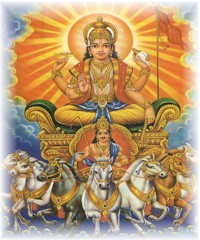
Lohri marks the end of winter on the last day of Paush, and beginning of Magha (around January 12 and 13), when the sun changes its course. It is associated with the worship of the sun and fire and is observed by all communities with different names, as Lohri is an exclusively Punjabi festival. The questions like when it began and why is lost in the midst of antiquity.
The origin of Lohri is related to Dulla Bhatti, the central character of most Lohri songs, A Muslim highway robber who lived in Punjab during the reign of Emperor Akbar. Besides robbing the rich, he rescued Hindu girls being forcibly taken to be sold to the slave markets in the Middle East. He arranged their marriages to Hindu boys with Hindu rituals and provided them with dowries. Understandably, though a bandit, he became a hero of all Punjabis. So every other Lohri song has words to express gratitude to
Dulla Bhatti.
Some believe that Lohri has derived its name from Loi, the wife of Sant Kabir, for in rural Punjab Lohri is pronounced as Lohi. Others believe that Lohri comes from the word 'loh', a thick iron sheet tawa used for baking chapattis for community feasts. Another legend says that Holika and Lohri were sisters. While the former perished in the Holi fire, the latter survived. Eating of til (sesame seeds) and rorhi (jaggery) is considered to be essential on this day. Perhaps the words til and rorhi merged to become tilorhi, which eventually got shortened to Lohri.
Ceremonies that go with the festival of Lohri usually comprises of making a small image of the Lohri goddess with gobar (cattle dung), decorating it, kindling a fire beneath it and chanting its praises. The final ceremony is to light a large bonfire at sunset, toss sesame seeds, gur, sugar-candy and rewaries in it, sit round it, sing, dance till the fire dies out. People take dying embers of the fire to their homes. In Punjabi village homes, fire is kept going round the clock by use of cow-dung cakes.
Myth of Fix date January 13th as the date of LohriThe Gregorian Calendar (The current english calendar) wasn't in use during Akbar's regime, and hence the question of using Jan 13th fix date wasn't practice then. Hence, it's clear that English date is used just for mere convenience as samkranti happens on January 14th nearly 99% times. This makes Lohri to come on January 13th in India. This gives a rise to the misbelief that
Lohri always come on January 13th.
If we believe that we always celebrate
Lohri on a fix date of January 13th and
Baisakhi on April 13th then how did we celebrate those festival before britishers came to India? India uses english dates from only 200 years, before that how did we celebrate
Lohri and
Baishakhi? Or we didn't celebrate at all because we weren't aware of the english date? We did. How did they determined
Lohri date in olden and golden times?
Please remember none of the Indian festivals are observed on a fix english date -- Not even Lohri or Baisakhi. Indian festival's date is calculated in the most scientific way. Do you want to know how our sages calculated
Lohri date when the english calendar wasn't available to them? Read further.
How to determine Lohri Date?Let's answer how did they find out the correct day for
Lohri. They knew how to calculate the position of the earth and the sun and sun's entering into zodiacs. They first calculate the time for the sun's entry into makara rashi.
Lohri is celebrated the day before makara samkranti -- previous night of makara samkranti. The earth, farthest from the sun at this point of time, starts its journey towards the sun, thus ending the coldest month of the year and announcing the start of the summer season. Sun is ready to move to uttarayana, and marking end of winter season. Usually sun enters into nirayana makara (capricorn) rashi usually on January 14th (99%). However, There are times when sun could enter makara rashi on a day before January 14th or a day after January 14th and the date for Lohri could be either 12th, 13th or 14th January depending on the time of sun's entry into makara rashi. This is also because next day of lohri is solar magha masa in punjab. Makara samkranti marks begining of the solar magha masa, and hence lohri has to be celebrated on the last day of the solar month Poh (Which maps to dhanur rashi of sun). For example if sun enters makara rashi on Jan 13th around 4 PM then makara samkranti is on January 13th and Lohri will be on Janary 12th but if sun enters into makara rashi on Jan 15th then lohri will be on Jan 14th. To celebrate lohri on a correct day please find the sun's entry into makara rashi in your area and the day before that transit is
Lohri.
The thing is 99.95% samkranti will come on Jan 14th in India. Sometime it will come before or after January 14th. If you live outside India one must apply timezone to sun's entry into Makara rashi. This will give you the date of makara samkranti in your country / area.
Indians use sidereal zodiac than tropic zodiac. In the sidereal or nirayana zodiac sun's entry into every rashi related to relatively fixed position of the star Spica (Chitra nakshatra). Due to various factors like earth's orbit, earth's movement around sun the phenomena of sun entering into zodiac is never fixed on a given date or time but most of times it will be fixed but not always.
Please read following article
http://www.mypanchang.com/Why-there-is-a-one-day-difference-in-hindu-festival-dates-in-India-and-America.php to understand why there is a difference between dates between India and other places.
Based on these calculations in the year 2008
Lohri in India was on 13th January, In seattle it was on 13th January and in Australia, Newzealand and Fiji it was on Janary 14th as makara samkranti was on Jan 15th in these countries.
How Punjab decides the beginning day of their Solar months?The punjab school for determining the first day of the month: When the samkranti occurs on the same day of the samkranti. The same day means from one midnight to another midnight. For example if sunrise is at 7:00 AM and sunset is at 6:30 PM but the day will be considered 00:00 AM midnight to 23:59 PM and the sun enters the new rashi during that time that will be considered as the first day of the month.
Lohri in 2009 Calculation example (for Seattle, WA and Pacific time zone).
A) Now let's open Indian panchang: Samkranti occurs at 6:22 AM on January 14th.
B) The standard time difference between India and USA(PST) is 13 hours 30 minutes.
C) Let's subtract B from A means 13 hours 30 minutes from January 14th's 6:22 AM. The result of the subtraction is January 13th 16:52.
D) This means in the Seattle Samkranti occurs at 4:52 PM (16:52) on January 13th 2009, and in India Lohri in India on January 13th as samkranti occurs there on January 14th 6:22 AM. Hence Lohri in seattle or rather entire Unites States is on January 12th and the Maghi is on January 13th. If you celebrate Lohri in the United States on January 13th then you'll be celebrating on a wrong day as it's a Maghi day -- day of new solar Magh month. Lohari is the last day of solar Poh (paush).
Our dharmashastra clearly mandates that we should take the date of the festival based on celestial events respect to the place we live. This clearly means where we are living and we have to calculate timings as per that location. We can't follow Indian timings outside India. Let me give you a real life example:
When you have a child born in your family in India on a given date say January 14th at 6:22 AM and time and you get a call right away it will be January 13th and 16:52 PM in Seattle. You don't wait till January 14th 6:22 AM in Seattle to congratulate your family members. You congratulate them right away. Likewise all celestial event occur at the same time and same instance all over the world.
The celebration of a festival on a right day creates right positive environment and positive energy is generated to help reach our prayers to god fast, and quickly. It's like gate to god is open for that window and after that it's closed. I'll plead everyone to use that open window and celebrate on the right date.
Lohri dates for 2009 USA / Canada / West Indies: January 12th 2009
Europe: January 13th 2009
Arabian Gulf Countries: January 13th 2009
Africa: January 13th 2009
India / Pakistan: January 13th 2009
China: January 13th 2009
Singapore / Malaysia: January 13th 2009
Japan: January 13th 2009
Australia, New Zeland, Fiji: January 13th 2009
Makara Samkranti dates for 2009 USA / Canada / West Indies: January 13th 2009
Europe: January 14th 2009
Arabian Gulf Countries: January 14th 2009
Africa: January 14th 2009
India / Pakistan: January 14th 2009
China: January 14th 2009
Singapore / Malaysia: January 14th 2009
Japan: January 14th 2009
Australia, New Zeland, Fiji: January 14th 2009